
Your dog's food passes every test | That is the problem.
Every bag says complete and balanced. Every label checks out. So why is there a whole category of nutrition that no bag is required to include? Here is what the label never told you.
The label is telling the truth | Just not the whole truth.
When a bag says complete and balanced, it is not lying. That phrase has a legal meaning. It means the food meets the minimum nutrient standards set by regulators. Enough protein to function. Enough fat to function. Enough vitamins and minerals to avoid deficiency.
It is a passing grade. And nobody ever asked whether your dog was getting an A.
Then there is what happens to the food before it reaches the bowl.
Kibble is blended, then forced through an extruder at very high heat and pressure. That is what gives every piece its shape. It is also what kills pathogens, which is genuinely good.
But heat does not discriminate.
Research suggests extrusion can degrade some vitamins and amino acids, and omega-3 fats are especially sensitive to heat and air. So manufacturers add vitamins back in, in synthetic form, at the levels needed to hit the numbers on the label.
The label still says complete and balanced. It just does not say how much of the original survived.
And the bag has been waiting. Unopened kibble can sit for 12 to 18 months. Once you open it, oxidation begins, and every scoop lets in more air. Most experts suggest finishing an open bag within four to six weeks. Most households take longer.
If you feed raw, you are already ahead of most. Raw-fed dogs often show better coat condition and healthier gut diversity than kibble-fed dogs.
Studies of raw and home-prepared diets keep finding the same gaps, commonly in iodine, zinc, copper, manganese, vitamin D, vitamin E and omega-3s. Not because owners are not trying. Because covering 20-plus micronutrients through food alone is genuinely hard, and even the best raw diet tends to be missing something.
Here is the part almost no one in the pet food industry talks about.
Nutrient standards cover the essentials, the ones a dog needs to avoid deficiency. They do not cover phytonutrients: the bioactive compounds in plants, including polyphenols and carotenoids, that do not prevent deficiency on their own but are linked to long-term cellular health, a balanced inflammatory response and immune resilience.
They are not on any regulatory checklist. They will never appear on a complete and balanced label. And they are almost entirely absent from both standard kibble and most raw diets.
Feeding quality kibble or a thoughtful raw diet is not the problem. Most owners doing that are already in the top tier of pet care.
The question is not whether your dog's diet is adequate. The question is whether adequate is enough.
Dogs age faster than we do. Small gaps that no single nutrient makes obvious quietly add up over months and years. Often what owners put down to him slowing down, or her always being a bit itchy, is simply the distance between minimum and optimal.
Fill The Gap From The Inside Out


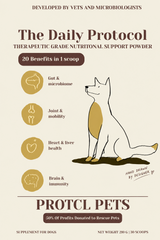

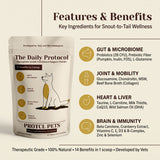

Your dog's diet passes every test. But the regulatory floor was never designed for optimal. The Daily Protocol adds what every diet is still missing, 20 active ingredients supporting 11 areas of health, in one daily scoop.
Fill The Gap From The Inside Out
Your dog's diet passes every test. But the regulatory floor was never designed for optimal. The Daily Protocol adds what every diet is still missing, 20 active ingredients supporting 11 areas of health, in one daily scoop.
Your subscription price stays the same for as long as you're subscribed.
Your delivery
Welcome gifts come with your first order. Change or cancel any time.